Paint Correction in Bolton, Greater Manchester
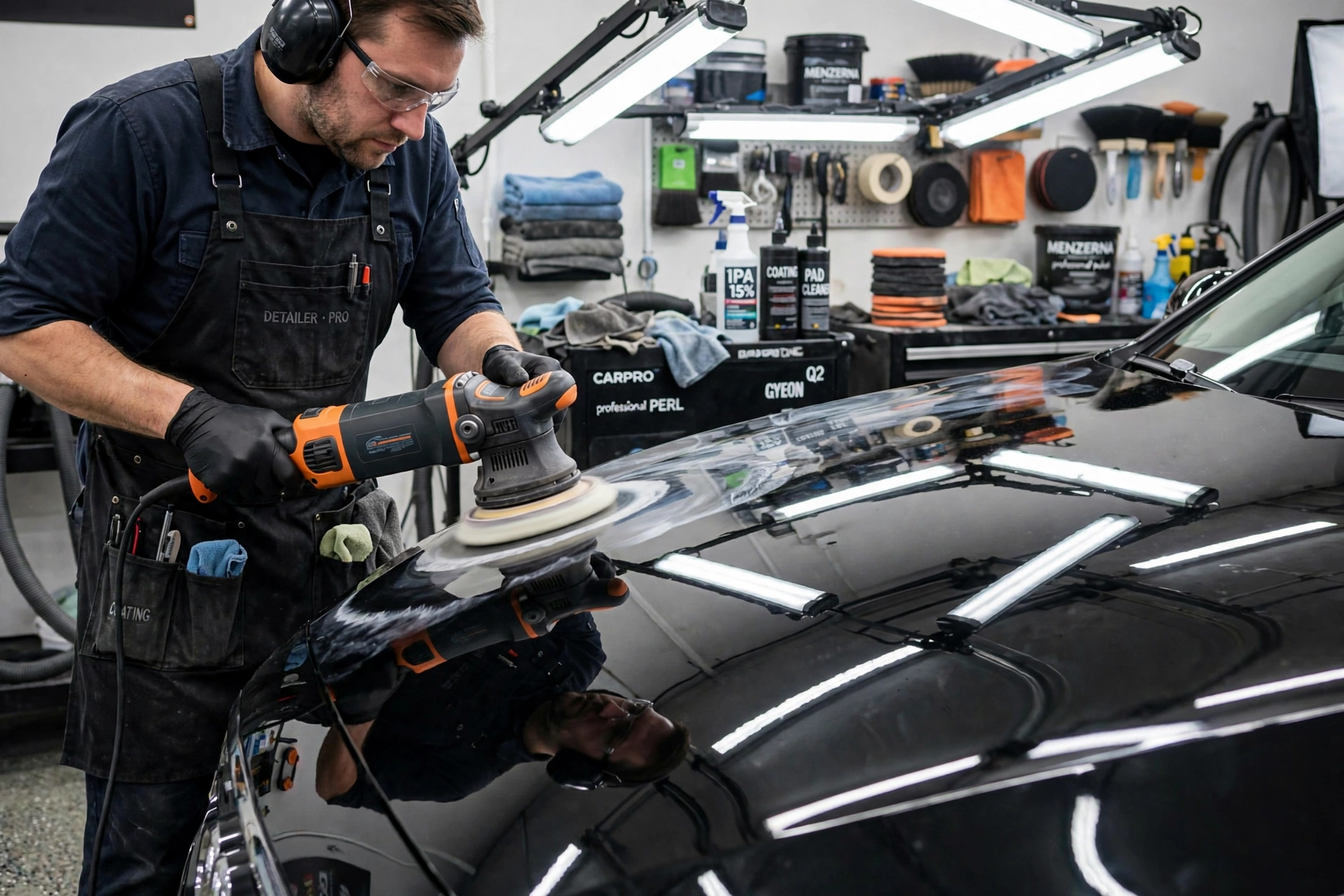
Paint correction is the machine polishing process that removes swirl marks, haze, light scratches and oxidation from your car's paintwork. Using machine polishers with graded compounds, a detailer levels the clear coat to restore depth and gloss. For Bolton drivers it's the essential foundation for ceramic coating — a coating locks in whatever finish is underneath, so correction comes first.
Key facts
- Fixes
- Swirl marks, haze, light scratches and oxidation living in the clear coat.
- Safety
- Paint-depth gauge readings guide how much clear coat can safely be levelled.
- Process
- 5-step correction process, from wash and decontamination to final inspection.
- Pairs with
- Ceramic coating locks in the corrected finish — correction first, coating second.
Swirl marks under petrol station lights. A hazy, tired look that no amount of washing seems to fix. Light scratches from years of automatic car washes and careless drying. These are the defects paint correction is designed to eliminate — not hide with fillers, but genuinely remove by carefully levelling the clear coat with machine polishers. It's the most transformative single service in detailing, and the before-and-after difference can be dramatic.
In Bolton, where cars face M61 motorway grime, winter gritting and frequent rain, paintwork takes a beating — and correction is also the essential preparation step before ceramic coating. A coating seals in whatever finish lies beneath it, so correcting the paint first is what guarantees that deep, mirror-like gloss lasts for years rather than months. Below, we explain how paint correction works, what it can and can't fix, and how we keep your paint safe throughout.
What Paint Correction Actually Involves
Paint correction is a controlled, measured process — not simply a good polish. We start by measuring your paint depth with a digital gauge, panel by panel, to establish how much clear coat there is to work with safely. Then, using machine polishers with cutting compounds and refining polishes, we remove a microscopic layer of clear coat to level out defects. The process is typically done in stages: a cutting stage to remove defects, then a refining stage to restore optical clarity and gloss.
A single-stage correction removes around 50–70% of defects and suits well-kept cars; a two-stage correction targets 80–95% and suits neglected or heavily swirled paint. We always recommend the least aggressive approach that achieves the result you want — preserving clear coat is preserving your car's future.
The Defects Paint Correction Can Fix
Most of what makes paint look tired lives in the clear coat, which means it's correctable. Years of automatic car washes, dirty sponges and dusty drying towels carve fine scratches into the surface that scatter light — that's the spider-web effect you see under bright lights. Correction levels these out so light reflects cleanly again, bringing back depth and colour.
- Swirl marks and spider-webbing from poor washing technique
- Holograms and buffer trails from bad machine polishing
- Light scratches that haven't gone through the clear coat
- Oxidation and fading on neglected paintwork
- Water spot etching and bird lime marks
- Dull, hazy finish lacking depth and gloss
Why Paint-Depth Gauge Safety Matters
Your car has a finite amount of clear coat — typically around 30–50 microns on factory paint — and every correction removes a little of it. That's why we measure paint depth on every panel before a machine polisher touches your car. Thin spots, previous repairs and resprayed panels all show up on the gauge, and we adjust our approach panel by panel to stay well within safe limits.
This is what separates professional correction from a risky buff-and-hope job. An aggressive compound on thin paint can burn through the clear coat — damage that can't be polished out and means a respray. Safe correction is slow, measured and methodical, and it's the only kind we do.
Paint Correction Before Ceramic Coating
Ceramic coating is optically clear — it magnifies whatever's underneath rather than hiding it. That's why correction and coating go hand in hand: the correction creates the flawless finish, and the coating locks it in and protects it for years. Skipping correction to save money usually means sealing swirls and haze under an expensive coating, which defeats the purpose.
Even brand-new cars benefit from at least a light refining polish before coating — new vehicles frequently arrive with dealership-installed swirls from pre-delivery washes. We assess every car individually and only recommend the level of correction your paint genuinely needs.
Our Paint Correction Process
Every correction follows the same careful sequence — measured, methodical, and safe for your paint.
- 1
Inspection and paint-depth readings
We wash the car, then inspect the paintwork under high-intensity lighting to map every defect. A digital paint-depth gauge records clear coat thickness on each panel, so we know exactly how aggressively — or gently — we can safely correct every section.
- 2
Decontamination and clay treatment
Polishing over dirty paint grinds contamination into the surface, so we fully decontaminate first: snow foam, iron fallout remover, tar remover and a clay bar treatment. Only perfectly clean paint goes under the polisher.
- 3
Test spot and correction plan
We polish a small test section to find the least aggressive combination of pad and compound that removes the defects. This test spot sets the recipe for the whole car — no guesswork, no unnecessary clear coat removal.
- 4
Multi-stage machine polishing
Working panel by panel, we cut out the defects with a compounding stage, then refine the finish with a finer polish to restore deep gloss and clarity. Paint depth is re-checked as we go, and edges and swage lines are treated with extra care.
- 5
Panel wipe, inspection and protection
Polishing oils are removed with a panel wipe, and the finish is inspected under multiple light sources. We then recommend the right protection — usually ceramic coating — to lock in the corrected finish for years.
Trusted further reading
- Halfords — Machine polishing guide — Polishing basics
Serving Bolton & Greater Manchester
Bolton's roads are tough on paintwork. The M61 commute coats cars in motorway film and stone chips, winter gritting leaves its mark, and tight town-centre parking around Victoria Square and the Market Place adds its share of light scratches. We correct paintwork for drivers across Bolton, Horwich, Farnworth and Westhoughton — and because so many of our correction jobs go on to be ceramic coated, every correction is finished to a standard worthy of being sealed in for years.
Areas we serve
BoltonHorwichFarnworthKearsleyLittle LeverWesthoughtonBlackrodAdlingtonBuryRadcliffeRamsbottomTottington
View all areas covered →Frequently asked questions
How much does paint correction cost in the UK?
Will paint correction remove all scratches?
Is paint correction safe for my car's paint?
How long does paint correction take?
Do I need paint correction if I'm getting ceramic coating?
Get your free, no-obligation quote
Tell us about your car and what it needs. We'll reply with an exact price and the earliest available slot.
Open 24 hours, 7 days a week — call or message any time.