What Is Ceramic Coating?
By Ceramic Coating Bolton · Published 2026-10-14 · Ceramic coating guides
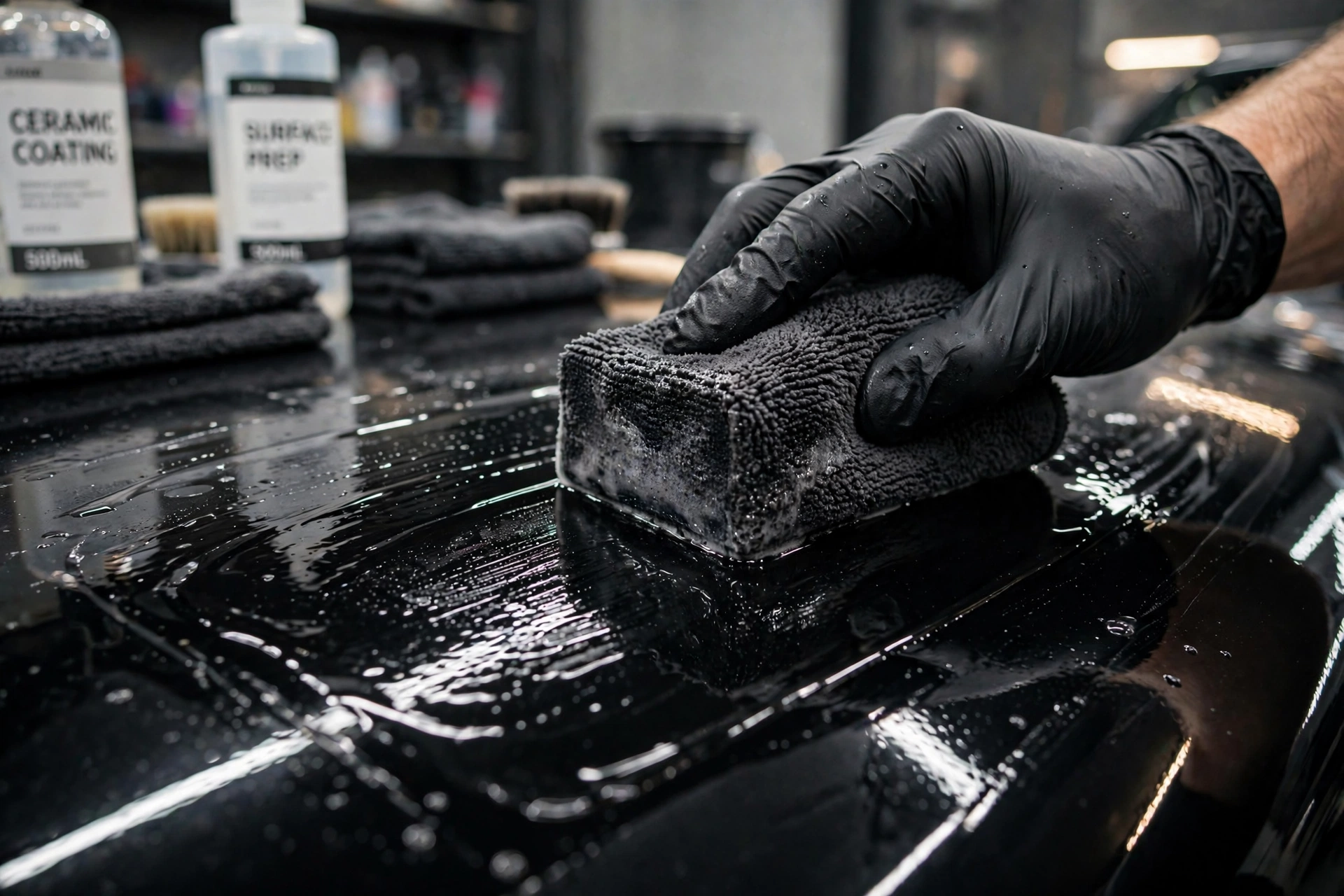
Ceramic coating is a liquid polymer containing silicon dioxide (SiO2) that chemically bonds to your car's paint, forming a hardened, semi-permanent protective layer. Once cured, it repels water, resists UV damage, and makes the car easier to wash. It does not make paint scratch-proof or remove the need for washing — it reduces damage and keeps paintwork glossier for longer.
Walk into any detailing studio in the UK and you'll hear the phrase 'ceramic coating' within minutes. Yet most car owners are unsure what it actually is. In simple terms, a ceramic coating is a liquid chemical product — based on silicon dioxide (SiO2), the main component of glass and quartz — that is applied by hand to a vehicle's paintwork. Unlike wax, which sits on the surface, it forms a genuine chemical bond with the paint's clear coat.
When that bond cures, the coating hardens into a thin, glass-like layer measured in microns. This layer is hydrophobic, meaning water beads up and rolls off rather than clinging to the surface, carrying loose dirt with it. It also adds UV resistance, chemical resistance against mild acids and alkalis, and a deep, glossy finish that wax struggles to match. Think of it as a semi-permanent shield rather than a cosmetic dressing.
How SiO2 Bonding Actually Works
Your car's clear coat is full of microscopic pores. When a ceramic coating is applied, its nano-sized SiO2 particles settle into those pores and begin to cross-link — forming chemical bonds with the paint as the solvents evaporate. This is fundamentally different from wax, which melts into a soft film held in place by weak physical adhesion. Once cured, typically over 24 to 48 hours, the coating cannot be washed off with soap; it must be machine-polished away.
What Ceramic Coating Does Do
A quality ceramic coating delivers several genuine, measurable benefits for everyday UK driving. The hydrophobic effect is the most visible: rainwater sheets off the panels, so the car stays cleaner between washes and drying becomes almost effortless. The hardened layer also resists UV oxidation that causes paint fade, offers mild chemical resistance against road salt residue and acidic contaminants, and locks in a high-gloss finish that makes the colour look deeper.
- Extreme water beading and sheeting — rain and rinse water run off, taking light dust with them
- UV protection that slows paint oxidation and colour fading on sun-exposed panels
- Chemical resistance to mild acids, alkalis, road film, and winter gritting residue
- A deep, candy-like gloss that enhances metallic and pearlescent paint finishes
- Easier, faster washes — dirt releases from the slick surface with less agitation
What It Can't Do (Honest Limits)
No coating is a force field. Ceramic coatings will not prevent stone chips from the M61, will not stop scratches from keys or car park brushes, and will not fix existing swirl marks or dull paint — those must be polished out before application. They also wear down: even the best coatings need maintenance and eventually require reapplication. If anyone promises a lifetime, scratch-proof finish, they are selling fiction, not protection.
Ceramic Coating vs Other Protection Options
Compared with traditional carnauba wax (weeks of protection) and synthetic paint sealants (months), a ceramic coating is in a different league: years of durability from a single application, far stronger hydrophobics, and genuine chemical resistance. The trade-off is preparation — wax can be slapped on in an afternoon, while a coating needs decontamination, paint correction, and careful panel-by-panel application in controlled conditions.
Frequently asked questions
Is ceramic coating the same as a wax?
Can ceramic coating be applied to any car?
Does ceramic coating make a car scratch-proof?
How long does it take to apply?
Get your free, no-obligation quote
Tell us about your car and what it needs. We'll reply with an exact price and the earliest available slot.
Open 24 hours, 7 days a week — call or message any time.